| |
Le Metro -- Deux jours à Paris : Arrival and Day 1 |
Now go here and:
Move the map around with the brown arrows. Move the map up and find the Aeroport Charles de Gualle. That is the airport at which you will land if you fly to Paris. Your Hotel is near the metro stop Bastille. So you have to take the Metro.
|
2. After taking a short nap, you want to get the lay of the land and see a few things Walking around Paris is a great way to see things, but it's such a big city! Grab the metro stop at the Bastille, and run over to the metro stop Cité. Remember to click on musées and monuments and then actualiser. What's on the island? The best way to view these things is to walk down the Promenade Maurice Carême, and then spend some time in the park on the corner of the island, Sq Jean XVIII.
|
3. Of course by now it's probably getting a little dark, so the best place to go if you're not too hungry is the Champs du mars/Tour Eiffel. From Cité you should only have to make one stop/transfer. Which line do you have to get on to get to the Tour Eiffel? Then you can see another one of the famous sites in Paris.
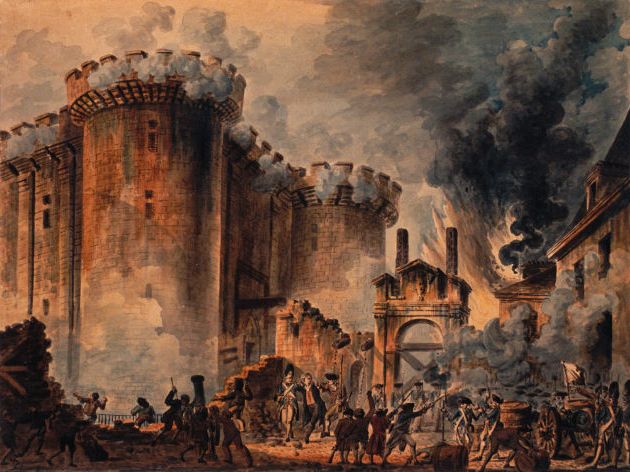
1. Click on the Blue 'B' next to Charles de Gualle and follow the blue line (which is the RER blue) down the map to the Châtelet/Les Halles. From there you have to go to l'Hôtel de Ville, and then on to Bastille. Of course, you won't see the Chateau de Bastille there anymore, it was torn down at the beginning of the French Revolution. What's there now is the Colonne de Julliet and the Opéra Bastille. 4. Now, you have to get back to the hotel though, and get some shut-eye for the busy day tomorrow. How can you get back to the Bastille metro stop? If you do it right, you should only have to make one transfer.
|
5. Ah, the nice Paris morning. I'm sure you're ready to go after grabbing a quick café and some pain au chocolat (a chocolate croissant)! It's relatively easy to get to the Louvre from Bastille. You have two choices; you can go to Palais Royale Musée du Louvre, or Louvre Rivoli. If you go via the Palais Royale stop, you can enter the museum via the controversial Pyramid; via Rivoli it's from underneath. You might want to go in via Palais Royale, and then exit via Rivoli so you can be on your way quicker, after all the next stop is the Musée d'Orsay. (Hint: The Louvre is a huge museum. But unfortuanately, seeing all those paintings at once kind of makes your mind turn to mush. Pick three or four items that you want to see and go and visit them exclusively. Often, all the paintings in memory blur into a rush of colour.) What are the three most famous things at the Louvre? What exceptional exhibits are there? How many civilizations are presented at the Louvre? And importantly, when is the Louvre closed (hours/days)? Of course, getting to where you want to go is not always easiest by Metro. Walk along the Quay des Tuileries and cross the next bridge to get the the Musée d'Orsay. What does the Musée d'Orsay have as its collection? What did the museum used to be, before it was renovated? What day is this museum closed? |
6. After running around all day, I'm sure you've become a bit tuckered out. Why don't you relax and wander around the Marais district of the city. Go to the metro stop Rambuteau. It's the pretty close to République and is closest to the Marais and a new museum. Take in the atmosphere of this little arrondissement and the famous Centre Georges Pompidou. After spending time today with all the great masters of art, at places so full of time, we need to compensate for stuff that is new and modern. This museum is for contemporary design and art. Can you find who designed the building? Who was Georges Pompidou? What day is this museum closed? Now, can you get back to your hotel? Remember, it's by Bastille. There are plenty of small restaurants nearby so you can grab something to eat on the way home, or eat in the Marais! There are some great small bistros. And don't forget to wander down towards the Seinne and look at the Hôtel de Ville after dark. It's the best with all the lights focused on it. It was in the square just before the Hôtel de Ville that one of the famous guillotines of the Reign of Terror was placed.
|
| |
| Day 2 |
| |
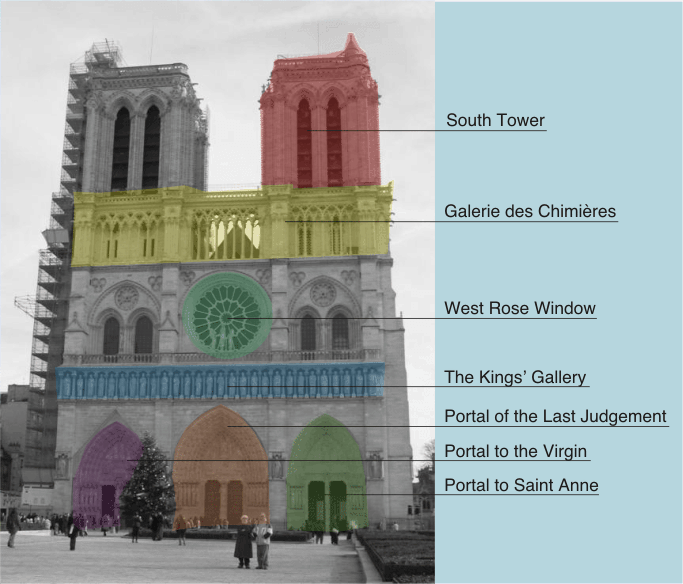
2. If you go here, you can find out more about Notre Dame de Paris. Now answer these questions: What was the cathedral built on? Who laid the cornerstone? What did Heraclius of Caesarea call for on the steps of the church? How long did it take to build the cathedral? What happened to all the statues' heads in the King's Gallery? Who wrote a famous book that helped fund the restoration of the cathedral? and the title of the book? What is so special about the rose windows and other stained glass windows in the cathedral? |
1. After waking up, did you go to the same café and get the pain au chocolat from the same bakery? You might try another bakery as they might have other things like a tarte au pomme. Yesterday you ran around to museums, churches and cemeteries -- you must think that your tour guide is crazy! But today, we'll be running around even more! First on the tour, is Notre Dame Cathedrale. It was probably closed when you went to see it the first night. So now, we'll go and take a look at it when we can walk around inside. The stained glass windows are amazing!! Go back to the metro stop Cité, and wander through the streets till you find it again. Now last time you may have noticed a bronze plaque stuck into the plaza before the cathedral. If you get a chance, go and take your picture there, as that is the heart of France. Every road in France is measured from that spot. And they say that if you get your picture taken there, you'll come back to France somehow, someday. Now look again at the façade of Notre Dame. Then, go inside the cathedral. Please, be respectful if there is a mass going on inside, just like you would be respectful of a Buddhist temple in Thailand (which are really neat too). |
| 3. Well, now that you know all about the cathedral and what is inside of it, let's look at one of the lesser known museums that shows what is under the Cathedral! Go to the Crypte Archéologique du Parvis du Notre Dame. It's nearby at
1, place du parvis de Notre-Dame. This place shows you ruins under the streets of Paris -- of Gallo-roman houses and streets, medieval houses and other interesting buried archeological treasures! However, don't come here if you are afraid of small, tight places. |
| 4. Of course, another horrible place to go that if you are claustrophobic is the Catacombs of Paris. Delightfully described by Ann Rice in her series Interview with a Vampire and Armand, the catacombs of Paris are full of history and all its bones. After all, this was also a place that the Resistance hid and worked during the Nazi occupation. At the metro stop Denfert-Rochereau look for the building at 1, avenue Colonel Henri Rol-Tanguy. What were the catacombs originally? Who is buried there? Who was caught having made a movie theatre in the Catacombs? |
| 5. Now we can go around the city and look at the smaller museums, some that hardly anyone knows about. If you like sculpture, you'll like Rodin. One of the most influential sculptors of his time, he helped change sculpture. Go from Ile de la Cité, to the one of the metro stops Varenne, Invalides or Saint-François-Xavier and look in the plan quartier for the street Rue de Varenne (it's number 77). You can visit the museum too here. Now, an important question is when is this museum closed? You can then find out specifics of his life, such as: When was he born? What sculptures besides 'The Thinker' ( Le Penseur ) did he create? How was his work first received? |
| 6. While Monet's famous gardens Giverny are outside the city, you can still certainly appreciate other Impressionists work at different museums in Paris. Go to
the metro stop Muette (Ligne 9) and look for
2, rue Louis-Boilly. There is the Musée Marmottan Monet. This place gives you a lot of information about him, even if you can't see his studios and gardens. Besides this museum owns Giverny, and has more of his paintings than garden museum. Now, try this and see if you can get this riddle correct. You can also play the other games there. |
| 7. You can visit a museum about Pablo Picasso, one of the Post-impressionists. It has over 3000 of his drawings, 200 of his paintings, 150 of his sculptures and a lot more! Go to metro stop
Saint-Paul, Chemin-Vert, or Filles du Calvaire and find the address 5, rue de Thorigny. Click on the link above and discover a bit about his life and works. |
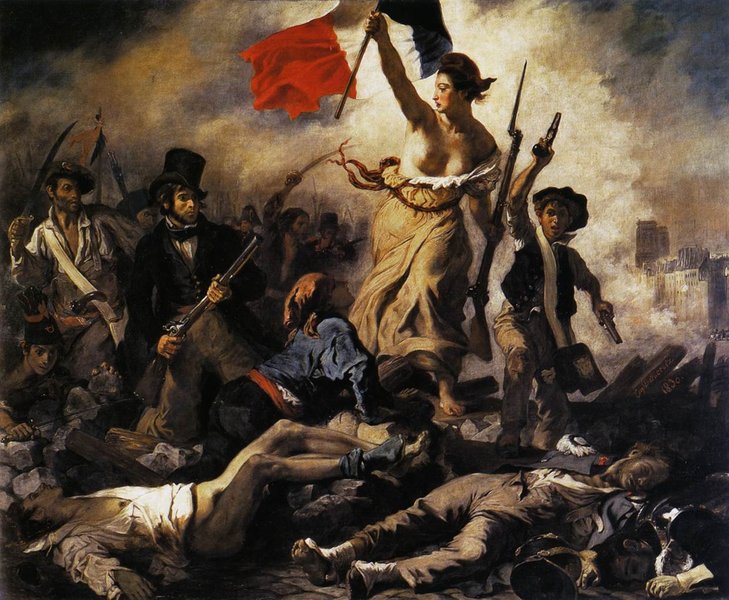 |
8. The museum of
(Ferdinand Victor) Eugène Delacroix is located at the Saint-Germain-des-Prés metro stop, and you can look for the
building
at 6 rue de Furstenberg. He was once a painter during the Revolution and helped paint this picture about lady Liberty leading the people in revolt against the king. Go to the link above, or click on the picture to learn more about Delacroix. Was he a painter from the Romantic period, or the Impressionist period? What was another painting he created? What was it that he tried to imbue in his works -- history, or the spirit of his people at the time? |
9. Now that you are probably all tuckered out, you can head back to the hotel. Or, if you still have energy you can go to some of the clubs that you saw on the Champs d'Elysée and party away the night. After all, your flight leaves in the morning! Bon Voyage! |
|